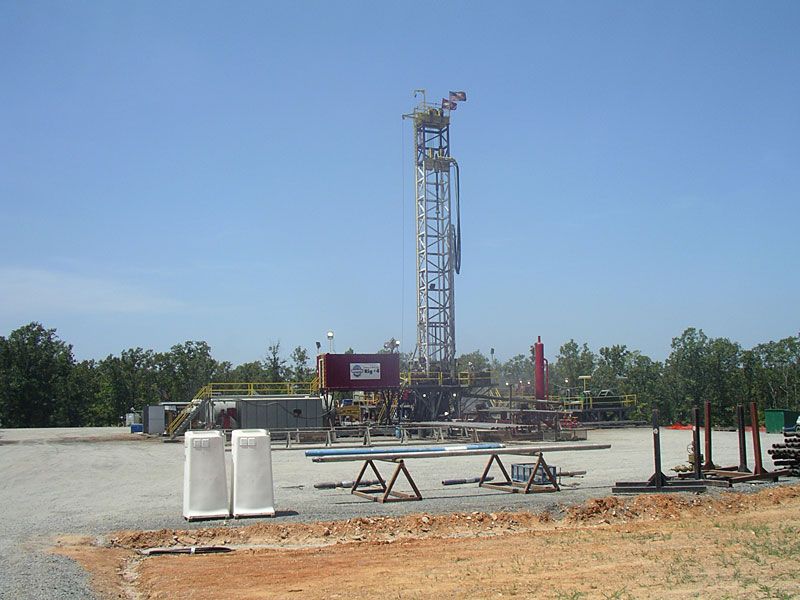
Get ready for new drilling for natural gas in the Fayetteville Shale Play.
Flywheel Energy Development LLC of Oklahoma City applied for permits to drill three wells in Cleburne County, the first new wells in the region in seven years.
The new wells add up to an investment of up to $30 million, the company said.
Chief Executive Officer Justin Cope cited “enhanced drilling and completion techniques” that are likely to make it economically feasible to go after natural gas in Arkansas once again.
The drilling hiatus struck after a decade-long boom in hydraulic fracturing in north-central Arkansas. But fracking’s quick success nationwide yielded such a glut of gas that prices collapsed, and boom turned to bust.
The rapid rise and fall of shale gas production is one of Arkansas’ signature energy stories of this century. Thousands of workers flooded Arkansas’ shale region, earning high wages that they lavished on local economies. Landowners reaped lucrative royalties on their mineral rights, but, alas, it didn’t last.
Arkansas’ natural gas severance revenue soared from $11 million in 2011 to $79 million in fiscal 2015. The next year, after gas prices fell by a third, the state reaped just $36 million. “Over just a three-year span, this volatility in natural gas prices caused a 50% drop in the Highway Commission’s severance tax revenue,” according to a paper that Macy Scheck completed when he was an undergraduate at the University of Central Arkansas. Scheck is now an assistant professor of finance at Lander University in South Carolina.
Flywheel owns about 5,600 wells in the Fayetteville Shale Play, and about 50 are still producing in Cleburne, Conway, Faulkner, Pope, Van Buren and White counties.
Pope said Flywheel is working toward adding hundreds of new gas wells.
“If successful, and with necessary commodity price support, Flywheel hopes to unlock hundreds of new locations for future drilling.”
But natural gas prices have stayed generally below $5 per million British thermal units except for extreme weather spikes. The spikes are costly for consumers and a shock to market systems, but usually quite brief. During the deep freeze of mid-February 2021, the Henry Hub spot price hit $23.86 per million BTU. Less than a month later, the price was $2.58.
But prices are trending upward.
The price was hovering around $4 last week, but the U.S. Energy Information Administration expects it to rise. By 2026, the average could reach $4.20, the EIA projected.
Summit Utilities’ 425,000 natural gas customers will be paying higher prices this spring as the second half of a 23.4% rate increase takes effect. The Arkansas Public Service Commission ordered Summit to deploy the rate increase in two phases to give ratepayers a break through cold weather.
Another factor in Flywheel’s decision to resume drilling is the Trump administration’s fondness for fossil fuels. “Starting on Day One, I will approve new drilling, new pipelines, new refineries, new power plants, new reactors, and we will slash the red tape,” Donald Trump said on the campaign trail.
Flywheel has a dominant enough position in the Fayetteville Shale to try to cash in.
It owns fields once held by Southwestern Energy, Van Buren Energy and Razorback Production, acquisitions worth some $2.6 billion. The company says it expects to develop five new wells this year, building on more than $300 million in capital improvement efforts.
 Sign up for Daily E-news