THIS IS AN OPINION
We'd also like to hear yours.
Tweet us @ArkBusiness or email us
Brain softening. Mind control. Subliminal and subversive.
I remember in the mid- to late 1950s, there was a controversy about injecting fluoride into municipal drinking-water systems nationwide. And into the processing of milk. Although fluoridation started in the 1940s, with the growing Cold War and the hunt for un-American Americans and a Communist behind every door and under every bed, fluoride emerged as yet another pinko plot.
Aided by the ultra right-wing John Birch Society, Americans and American institutions were warned against fluoride. The conspiracy theory was that fluoride was a way for the communists to soften our brains, making them more vulnerable to manifesto-inspired thinking about class struggles and the restructuring of the American dream into a nightmare, saved only by evolution through dialectical materialism.
Holy hammer and sickle!
Given recent revelations about Russian involvement in the 2016 presidential election, is social media the new fluoride?
Let’s set aside the Russians for now, and simply look at social media, particularly Facebook, and what the strategy has been to grow the business into a medium and a social and political juggernaut.
In an early November article on Inverse, an online site dedicated to analyzing culture and science, Sean Parker, the co-founder of Napster and original president of Facebook, said of social media: “I don’t know if I really understood the consequences. It literally changes your relationship with society, with each other. It probably interferes with productivity in weird ways. God only knows what it’s doing to our children’s brains.”
As a communications channel, a social networking service to its members and as an advertising medium, Facebook has transformed media consumers into media engagers. And its amplitude may soon be measured by share of engagement, time and mind. Some say Facebook’s individual account usage, at a daily average approaching one hour or more, borders on addiction. Facebook no doubt would counter that notion with a well-documented statement confirming brand loyalty. Advertisers like that brand loyalty.
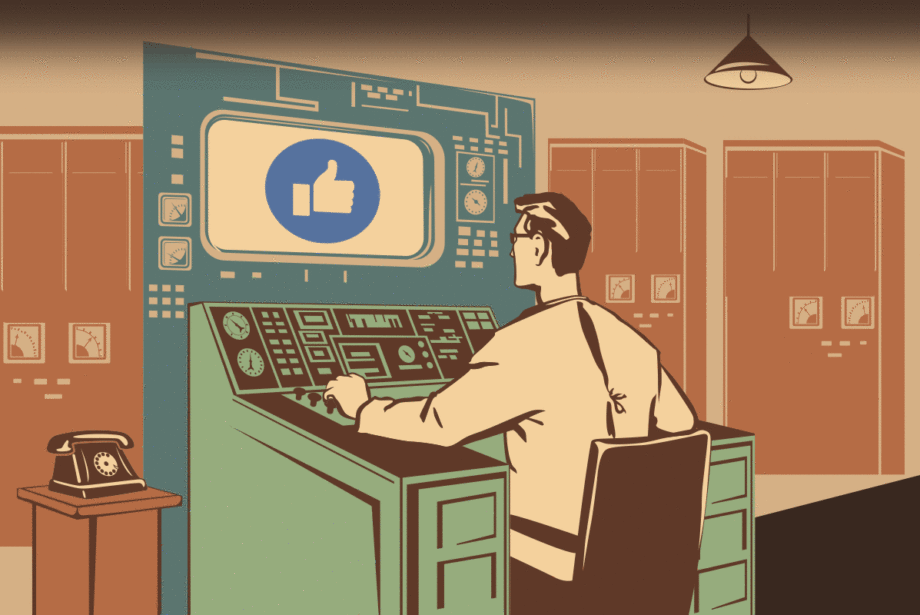
But here’s the deal. And it’s scientific: When users check in on Facebook and experience “likes,” positive or agreeable comments, social approval or validation, it releases dopamine in the brain. Dopamine is a chemical in the brain that acts as a neurotransmitter along several pathways. One of the pathways leads to a part of the brain that stimulates reward-motivated behavior, including pleasure. Facebook use is pleasing to the brain. Likewise, negative reinforcement through Facebook messages, images, videos and the like, can stimulate anxiety and depressive emotions, particularly among young adolescents.
Who knew?
Researchers refer to this as the dark side of social media. They also are aware of the impact social media, in our case Facebook, can have on what is called social marketing or behavior-change marketing.
Savvy branding agencies are now approaching consumer behavior strategies using Facebook and other social media platforms because they are highly targetable, have the power to influence and are affordable.
Messages on Facebook can be directed to the brains of those particular consumers that advertisers (or others) are trying to reach. Facebook targeting can be delineated by demographics (sex, age, income, education, ethnicity), geographics (where you live and, more importantly, where you are) and psychographics (most dominant or frequent attitudes, aspirations and activities).
The way Facebook is set up as a social network can influence opinions and behavior through social proofing, endorsements, critiques and reviews. And it is done somewhat passively through conversational and casual messaging.
Paid-weight “boosts” behind messages — posts, advertisements, articles, news feeds — are cheap compared with other types of advertising. With these budgetary efficiencies comes the ability to achieve greater frequency — getting in front of your eyeballs over and over.
So when you check your Facebook account on your smartphone, remember, you are initiating the engagement. It’s not like a TV ad that is pushed toward you. You’re looking for a post, a photo, a video, an event, an opinion or a recommendation. And you are a willing receptor of all that. You like it. So does your brain. And if you like it, you’ll probably do it again. In about 15 minutes.
 |
Craig Douglass is an advertising agency owner, and marketing and research consultant. He is president of Craig Douglass Communications Inc. of Little Rock. Email him at Craig@CraigDouglass.com. |
 Sign up for Daily E-news