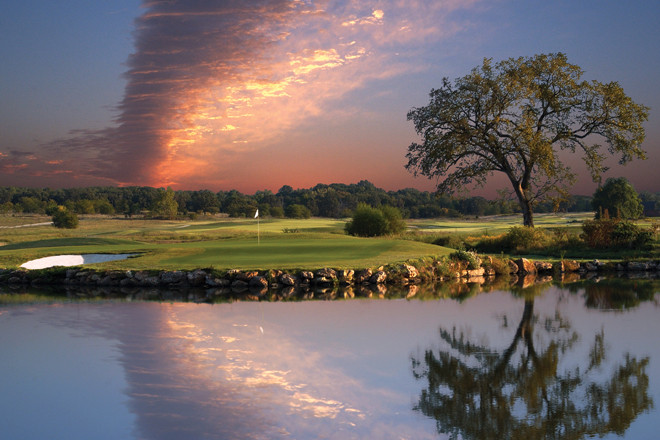
Big Creek Golf & Country Club in Mountain Home.
Golf is still a hard sell in Arkansas.
More than 10 years after the formation of the Natural State Golf Trail, the sport is struggling to regain its popularity, especially with a younger generation that seems more interested in smartphones than sand wedges.
Arkansas, like many other states, saw a surge in golf interest when Tiger Woods stormed to the top of the PGA. That boom eventually began to abate and then took a hit during the recession of 2007-08. People trying to make ends meet or looking for a job didn’t spend a lot of money on golf during the lean years.
“Golf participation went down significantly across the nation — 3-5 percent a year for the last 10 years,” said Jay Fox, executive director of the Arkansas State Golf Association. “For a long time, golf was on the decline. We think it has plateaued. We’re starting to see our tournament revenue [return], and we’re starting to see people coming back and playing. Our membership has flattened out, if you will.”
Laura Nix, executive director of the nonprofit First Tee of Central Arkansas, said her organization’s numbers have been good. First Tee provides life development training through golf for children ages 5-17.
Nix said regular participants have remained in the 600 range, and retention rates have recently begun to improve. In 2012, 38 percent of her participants returned the next year, but in 2014 that number improved to 57 percent.
Through an outreach program, Nix said, First Tee provides golf and other services to as many as 1,400 more children.
“We don’t see any downturn,” Nix said. “Because we’re doing more outreach, we actually see quite a few kids taking up the sport. The issue is keeping them interested. It’s not an easy game.”
Following the Trail
The ASGA is one of the organizations involved in the Natural State Golf Trail, along with the state’s Department of Parks & Tourism, the Arkansas Hospitality Association and the 12 private and public golf courses that make up the trail’s sites. The trail was the brainchild of Lang Zimmerman, co-founder of Big Creek Golf & Country Club in Mountain Home.
Zimmerman thought Arkansas would benefit from a golf trail patterned after those in states such as Louisiana and, most famously, Alabama. Zimmerman submitted a proposal to Richard Davies, who was executive director of the Department of Parks & Tourism at the time, and the trail was officially launched in July 2004.
“It has been successful in that it has given Arkansas a golf product like a lot of other Southern states have,” said Zimmerman, who is a member of the Arkansas Economic Development Commission. “The downturn of the economy in ’07-’08 really put a crimp on a lot of tourism. A lot of people quit traveling, and a lot of people view golf as discretionary spending. We’re just starting to see in the last couple of years where that is turning around. People are a little more willing to spend money to travel and play golf. It’s nowhere near what it was before the recession.”
Jim Shamburger, the president of the Natural State Golf Trail, said the state provides approximately $70,000 a year through the Parks & Tourism Department to help promote the trail. Shamburger said the organization is getting good results with direct-email marketing and promotion of its package deals.
“It’s another niche market for the state to promote to get people to come to Arkansas,” Shamburger said. “The state money has been there every year. We have to be smart with our marketing.
“Golf is having a struggle. It is in a transitional period; golf courses have to be leaner and meaner and smarter with their money, and we have to be smarter with our money.”
Finding Time and Players
Fox said he recently spoke with a former junior player at a golf tournament and mentioned that it had been a while since he’d seen the young man play.
“He said, ‘Mr. Fox, life got in the way,’” said Fox, adding that the man had gone to college, married and now had a job and children. “That’s kind of what happens. Your life gets in the way.”
Fox said the ASGA’s junior tournaments are still strong, but those players often drift away from the sport as they get older.
Zimmerman said he has had fewer juniors playing in tournaments held at Big Creek, but that may partially be due to Mountain Home’s remoteness and the added trip expenses involved.
Zimmerman said golf may need another Tiger Woods-like phenomenon to reignite interest because the cost of playing is a deal-breaker for many.
“Golf is an expensive game, and there’s no getting around it,” Zimmerman said. “It takes a ton of land, takes labor and maintenance to make it happen, and it takes people who are really serious about it to keep it alive. Golf is not as popular. I don’t think it is approaching tennis. I see golf going a little bit in that direction rather than the rah-rah years of Tiger Woods mania.”
Fox said the ASGA had planned for the decline in participation by developing additional sources of revenue. Instead of raising membership dues, the association began to partner with various companies. Fox said as much as 20 percent of the ASGA’s revenue now comes from those partnerships.
Fox said Stonebridge Meadows in Fayetteville, a member of the Natural State Golf Trail, recently canceled an ASGA event because it wanted to keep that block of Saturday and Sunday tee times open for paying customers.
“The discretionary dollar, the recreational dollar is in high demand,” Fox said. “It has been a struggle for the last eight to 10 years. Our tournament participation was down the last few years, and then last year it flattened out. We’re hoping it is going to turn back around and head back in the right direction. We’re doing all we can to help our member clubs get additional revenue.”
 Sign up for Daily E-news