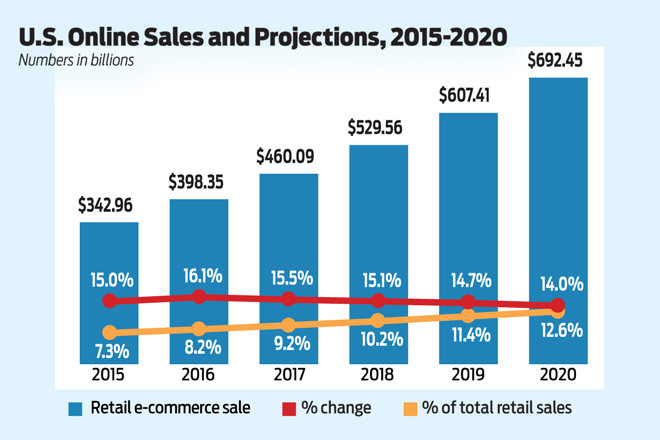
Online sales grew to 8.2 percent of all retail sales in the U.S. last year, and projections of continued growth finally seem to be creating the political will to tax internet purchases.
Last week, the Arkansas Senate Revenue & Taxation Committee, with no opposition, endorsed a bill that would require online retailers to collect sales tax and submit it to the state. State Sen. Jake Files, R-Fort Smith, a co-sponsor of the bill, said it might be this week before the legislation is presented to the Senate for a vote.
And in Washington, stalled federal legislation to force online retailers to collect sales tax is gaining support, U.S. Rep. Steve Womack said, if it can just get out of committee.
Files’ bill in the General Assembly calls for out-of-state online retailers to collect sales taxes if they sell more than $100,000 in merchandise in Arkansas or have at least 200 separate sales transactions annually.
It’s the very sort of “Main Street fairness” that brick-and-mortar retailers, not to mention local elected officials, have been seeking for nearly a decade.
Mayor Mark Stodola estimated the city of Little Rock has missed out on about $5 million in sales taxes in 2013-16 because out-of-state online retailers, such as Amazon.com, currently don’t have to collect sales taxes on internet sales if they don’t have a physical location in Arkansas.
Not having that money “has a great impact,” he said. “It hurts and it stunts the ability for us to be as effective as we can in terms of providing services.”
Stodola said he hopes that renewed interest in the issue at the state Legislature and in Congress ends the favorable treatment online retailers have enjoyed by forcing them to start collecting sales taxes just like traditional retailers.
Retailers that have physical stores in the state are required to collect sales taxes on merchandise sold online, as Wal-Mart Stores Inc. of Bentonville does on Walmart.com. And Arkansas consumers who buy items tax-free online are supposed to submit the tax to the Arkansas Department of Finance & Administration. But almost no one does.
For the fiscal year that ended June 30, 285 taxpayers submitted state and local sales taxes that totaled $71,400. So far this fiscal year, just 68 taxpayers have paid a total of just $29,700, according to DF&A.
Files didn’t have an estimate on how much sales tax money the state is missing out on. Because the requirement to pay taxes on online purchases is already on the books, Files said, it is a misconception to say that the bill he co-sponsored is creating a new tax.
In addition to losing revenue and maintaining what is seen as a disadvantage for those retailers that have no investment in the state, Arkansas is also falling out of step with surrounding states, which have begun capturing sales taxes from online sales. Last week, Amazon, which doesn’t have a physical location in Missouri, said it would start collecting sales tax for that state.
Congressman Womack, the Republican whose district includes Wal-Mart’s headquarters, was part of a bipartisan group of lawmakers who first introduced legislation to force online retailers to collect sales taxes in 2013. He has renewed his push to get the Remote Transaction Parity Act through Congress, but it is stuck in the House’s Judiciary Committee.
“It will pass the House if it ever comes to a vote,” Womack told Arkansas Business last week. “I think there’s much more support for it than before.”
He said he’s seen estimates that more than $20 billion in sales taxes aren’t being collected across the country.
“It’s beginning to hurt a lot of these municipal offices and county offices,” Womack said. “Our state governors are now weighing in. They know this is a problem that’s going to get worse and not better.”
Gov. Asa Hutchinson said Wednesday during a news conference that he hadn’t looked closely at Files’ bill. But, he said, “I’ve been an advocate for e-fairness.”
The issue comes at a time when states are looking to boost their coffers and consumers continue their transition away from brick-and-mortar stores to online shopping.
And the online battle is heating up. Last fall, Wal-Mart announced its $3.3 billion purchase of Jet.com of Hoboken, New Jersey. And last week, the Bentonville retailer said customers could use two-day shipping without having to be a subscriber, a competitive response to Amazon’s popular Prime membership, which costs $99 a year.
Online Sales Growth
From essentially zero in the mid-1990s, online sales now account for 8.2 percent of all retail sales in the U.S., according to eMarketer, a market research firm headquartered in New York. By 2020, eMarketer projects 12.6 percent of total sales in the United States will be completed online.
There are several reasons for online sales growth, including convenience, said Roshan Varma, a vice president in the retail practice at AlixPartners LLP of New York, a global multi-industry consulting firm.
Varma said people have high-speed internet access at work, and then when they get home, they’re usually on the couch with a mobile device in hand, making it easy to shop online rather than trudge to the store.
The customer experience also could be better online than with a salesperson, especially if the clerk is rude or an item is out of stock, Varma said. Online shopping also has made comparing prices between retailers effortless, he said.
One thing Varma doesn’t know is just how big a piece of the retail pie will be captured online before it levels off.
Paula Rosenblum, a managing partner of RSR Research LLC, which provides research for the retail industry, said the growth of online sales hasn’t surprised her. “Customer trends and tastes are really shifting,” she said.
Rosenblum said department store Neiman Marcus now claims 26 percent of its sales are online. And Nordstrom is at about 20 percent.
But only about 3 percent of Wal-Mart’s sales are made online. “So some companies … have a tremendous amount of headroom left to go,” she said.
Revenue Concerns
Nearly 20 state legislatures have bills pending that would require out-of-state online companies to collect and hand over sales taxes, said Max Behlke, director of budget and tax policy for the National Conference of State Legislatures in Washington.
“Sales taxes are the second-largest revenue stream for states,” he said. “If they’re not able to collect all their dollars they’re owed, it puts them in a pinch.”
And that money is needed. He said more than 30 states are facing budget shortfalls this year, with few options aside from slashing spending or raising taxes. “It’s a lot easier to collect dollars that you’re owed,” he said.
Last year Alabama put an online tax on the books and generated $50 million, he said. The law, however, is now on hold pending a court challenge, he said.
States wanting to tax online sales received good news in December when the U.S. Supreme Court let stand a Colorado law that called for online retailers to collect the sales tax.
Behlke said an argument that retailers used to use — that it was difficult to calculate the sales taxes in various jurisdictions — is no longer valid because software programs are widely available to handle that task.
In addition, a revenue threshold has to be met before the tax starts being collected. So the person who sells a few items on eBay doesn’t have to worry about collecting the sales tax, Behlke said.
The legislation is “going after the medium to large businesses that have the ability to collect, but just aren’t,” Behlke said.
Charlie Spakes, president of the Arkansas Grocers & Retail Merchants Association, said the association’s approximately 300 members support Sen. Files’ bill.
“It’s a big deal for my big members that have stores everywhere and have to pay, and then it’s a big deal for my real small stores that are just Arkansas-based,” Spakes said.
He said members have told him that customers come in, try out a product and then order it online, where they don’t have to pay sales tax.
Behlke, with the National Conference of State Legislatures, said the retailers that are hurt the most by that practice, known in the industry as “showrooming,” are jewelers and those that sell high-end electronics.
Rep. Womack said the Remote Transactions Parity Act would create a level playing field for all retailers while boosting revenue to states. “With the increased attention, this might be the year that we finally see a version of this bill get across the finish line,” he said. “I remain optimistic.”
 Sign up for Daily E-news