Founder | Tyson Foods
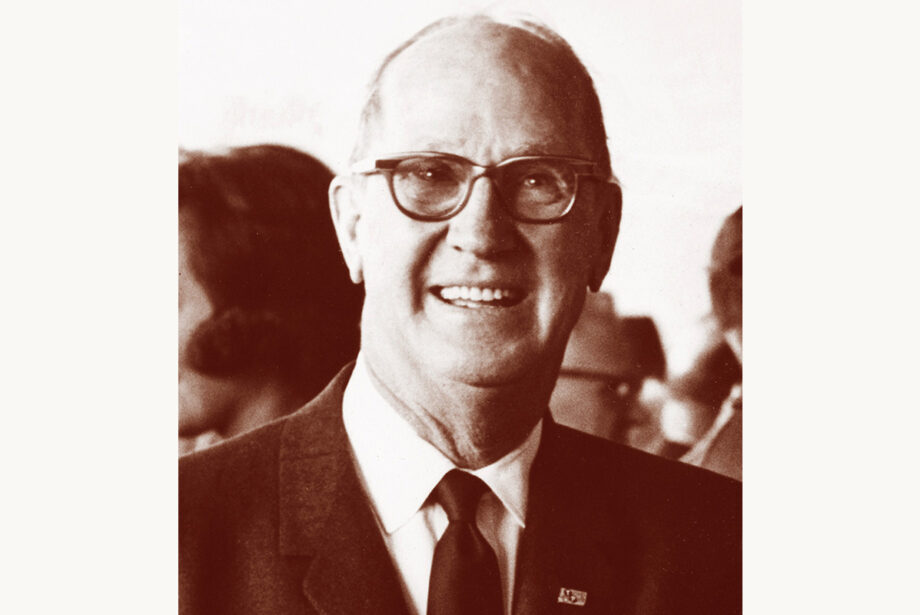
With a battered truck, half a load of hay and only a nickel in his pocket, John W. Tyson needed to hustle. It was 1931 and the Great Depression. John had moved to Springdale, Arkansas, from Olathe, Kansas, with his wife Mildred and his one-year-old son Don.
With that nickel, he bought a cup of coffee and then looked for work hauling produce or hay or chickens.
This modest start laid the foundation for a future Fortune 100 company.
Early Life
Tyson was born on a small farm in Mound City, Missouri, to Isaac and Anna Tyson in 1905. Four years later, John and his family moved to Olathe, Kansas.
When the Great Depression hit, John hauled hay from his family’s farm to sell. He would return with a load of fruit. Once the fruit season ended, he hauled chickens.
John moved his family to Arkansas looking for better opportunities. He found them.
In the 1930s, most chickens were grown locally and hauled to nearby cities. Without federal highways and refrigeration, truckers were limited where they could deliver birds. By 1935, John was making runs to Kansas City and St. Louis with live chickens on a flat bed trailer. He stacked and nailed chicken coops onto the trailer and devised an in-transit feeding system, which allowed longer hauls.
In 1936, John read that chicken prices were higher in Chicago. With a $1,000 loan and $800 of his own money, John loaded up 500 spring chickens and made the 1,400-mile roundtrip to Chicago using his in-transit feeding system. He made $235 profit.
This Chicago trip changed John’s business and soon he was driving to Cincinnati, Detroit, Cleveland, Memphis and Houston.
Having been divorced several years earlier, John married Helen Frances Knoll in 1941 and they had a son Randal, born in 1952. For a number of years Helen managed the bookkeeping for Tyson’s businesses.
Trucks, Hatcheries and Feed
Obstacles presented unique solutions and new business growth for John. When a supplier could not keep up with his need for baby chicks, John bought an incubator to hatch them himself. Soon, he began to sell chicks to growers. After realizing the critical need for feed, he became a commercial feed dealer for Ralston Purina.
With each new venture, John diversified and grew his business.
World War II increased the demand for poultry because chicken was excluded from food ration stamp restrictions. With more demand for chicken, John needed more truck drivers. However, he could not send drivers out on Thursdays and Fridays, because they would arrive at terminals on the weekend when terminals were closed.
John could not afford to have stalled drivers on the payroll on Thursdays and Fridays, so he got them to mix feed. Now Tyson was in the feed business and soon began to buy and mix his own wheat bran, corn and soybean meal. He built a commercial mill and bought a feed mixer.
John bought 40 acres next to U.S. 71 in Springdale in 1943 and then purchased a few small broiler houses. In 1945, he transitioned to New Hampshire Red Cristy chickens, a meatier bird.
In 1947, Tyson Feed and Hatchery was incorporated, providing chicks, feed and trucking services for local poultry farms. Tyson located the company in downtown Springdale, close to Armour, Swanson and Swift processing plants.
By the late 1940s, the poultry market changed with the invention of refrigerated trucks and more efficient production methods.
John soon developed a vertically integrated business by contracting with local farmers to grow his baby chicks and paying them a fixed price based on weight gain. He would then market and sell the chicken. He provided more services – marketing, sales, feed production and poultry processing – to complete the business model.
By 1950, Tyson Feed and Hatchery processed 12,000 chickens a week, employed 52 people and grossed $1 million per year. By 1957, the company produced 10 million broilers.
In the 1950s and 1960s, poultry prices fluctuated and competition got tougher. To grow the company, Tyson bought out local competitors and strengthened his vertical integration model.
In 1952, John’s son Don left the University of Arkansas and joined his dad’s business. Seeing the need for a chicken processing plant, Don urged his dad to build one. Don oversaw the construction of the plant. In 1958, the processing plant was completed and further extended the vertical integration model. Don became the plant manager.
John hired Leland E. Tollett in 1959 as the director of research and nutrition. In 1961, John hired Donald “Buddy” Wray as a service technician. Tollett and Wray joined the management team and, along with son Don, they helped John W. grow and develop the company.
In 1963, Tyson changed the company’s name to Tyson’s Foods Inc. and took it public through an initial stock offering of 100,000 shares at $10.50 each. The company expanded its product line with turkeys, Cornish hens and eggs. That set the stage for flexibility, change and growth, a strategy that stays with the company today.
By 1965, Tyson’s Foods produced 42 million birds annually, 2 percent of the national broiler business. John turned the reins of the company over to Don as president in 1966 but stayed as chairman and chief executive officer.
On January 15, 1967, John and Helen’s vehicle was broadsided by a train near Springdale and were both killed. In its “Founders Room” at the Tyson World Headquarters, the Fortune 100 company has a replica of Tyson’s office the way he left it in 1967 with his wire-rim glasses on his desk, and his brown hat on a rack in the corner. John W.’s innovative spirit lives on through the company’s growth, product development and integrated way of doing business.
Community
John W. Tyson was active in many organizations. He was director of the National Broiler Council, chairman of the Arkansas Alcoholic Beverage Control Board and member of the Arkansas Racing Commission. He was also a Rotarian, Mason and Shriner.
After Don Tyson took over the company in 1967 and ran it as chairman and CEO during most of the next 30 years, his son John H. Tyson became chairman and CEO in the late 1990s and leads the company today as its chairman of the board.
See more of the Arkansas Business Hall of Fame.
 Sign up for Daily E-news