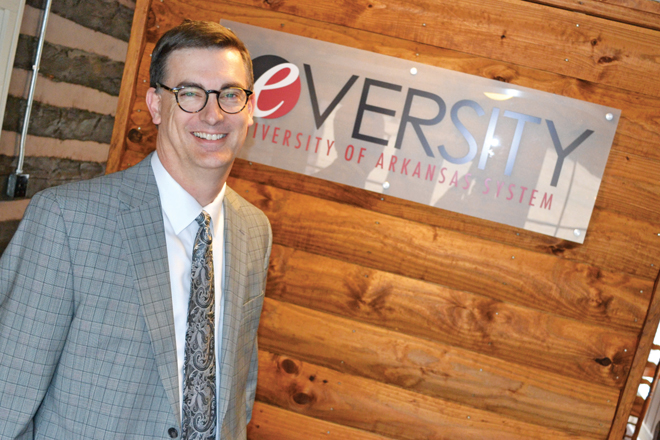
Michael Moore, vice president for academic affairs, says single, shorter courses are key to successful online experiences for nontraditional students.
Some of the doorways in the “brown house,” the historic Cammack Village family home on the University of Arkansas System property in Little Rock, are too short for Michael Moore to pass through without ducking.
The irony is not lost on Moore: He has the job of setting up eVersity, the UA System’s high-tech online-only university, and his staff is in a log cabin furnished with surplus metal tanker desks from the 1950s.
As vice president for academic affairs, Moore’s personal office is in the UA System headquarters next door, so he isn’t bumping his head all day long. But he is navigating an ambitious project: combining technologies and techniques that have been proven to work elsewhere into an entirely new UA member university.
“I don’t have a single innovative, unique idea,” Moore said in a recent interview. “What we’re doing is seeing the effective things others are doing and bringing them all together. That’s the unique, innovative thing we’re doing.”
Moore, a political scientist by training, was lured to the UA System in December 2012 by Donald Bobbitt, who was hired as system president the previous year. The two had worked together at the University of Texas at Arlington, where Moore had developed online and distance education programs.
Expanding the UA System’s online offerings was part of Bobbitt’s pitch when he was hired, and come October, Moore intends to bring those promises to fruition with the first eVersity course. Launching in October rather than January or August underscores a fundamental difference between eVersity and the online offerings of traditional brick-and-mortar colleges — even those that offer some courses online: Sixteen-week semesters are old school.
“The needs of the student population that we intend to serve are really significantly different,” Bobbitt said last week. “There’s no need for us to run a calendar based on an agricultural calendar that was set 150 years ago when everyone needed to plant in the summer.”
Instead, the first offering in October will be an orientation course designed specifically to make sure that eVersity students understand what they are getting into. A similar prep course, Moore said, would probably benefit all college students, but it is especially vital for the type of student that eVersity is targeting.
And that student is not fresh out of high school. “We’re not interested in 18- to 22-year-olds,” Moore said matter-of-factly.
Bobbitt, in fact, said he firmly believes that the traditional college student still benefits from the traditional, face-to-face college experience.
“If you are an 18- to 22-year-old and you have the resources and the maturity to live alone, then that’s the preferred mechanism for you,” Bobbitt said. He is, after all, also the president of 17 other four- and two-year schools in the UA System.
But Moore and Bobbitt think there are more than 300,000 Arkansans who already have some of that traditional college experience under their belts, and about 20 percent of them are within a year of getting some kind of degree and all the economic benefits that come with it.
(Also see: UA eVersity’s Michael Moore Wants Path to Hard Work To Be Easy)
“We’ve got a lot of people in small-town Arkansas or, heck, big-town Little Rock who, because of life, can’t go to a traditional college,” Moore said.
Some 14,400 of them are already taking fully online college courses from other providers out of state, whether public or private for-profits like the University of Phoenix.
These potential students are the market eVersity will target. Starting in January 2016, eVersity will offer six-week courses that are:
- Created jointly by UA faculty members expert in the subject matter and instructional designers trained in the best ways to teach the material online,
- Taught one at a time,
- Available at each student’s convenience (“much like your on-demand programming,” Bobbitt said, although educators use the term “asynchronous”) and
- By experienced UA System instructors with full benefits who are paid extra as eVersity adjunct instructors.
The courses will lead directly to associate degrees and then bachelor’s degrees in information technology, business, criminal justice or health care management. Moore is also knocking around the idea of developing intermediate “certificates” that would indicate successful completion of courses that teach related skills.
Single, shorter courses are key to successful online experiences for nontraditional students, Moore said.
“With adult learners, this works fantastic,” he said. “These are students who say, ‘My life is busy. I can take on [only] one more thing right now.’”
And if it turns out that the student can’t handle that one more thing, he or she has only been set back by six weeks, not six months, Bobbitt said.
At a pace of one six-week course at a time, with a week in between, it would take six years to earn a bachelor’s degree “if you start at zero,” Moore said. “But that’s not our market.”
Cost Control
The University of Arkansas Board of Trustees loaned eVersity $5 million for startup costs — and startup is a word Moore uses to describe the new venture. Otherwise, eVersity has not asked to be subsidized by taxpayers, as is the case with all other state-owned colleges and universities.
Each three-credit-hour course is expected to cost $510, Bobbitt said, although the price point has not been set.
“We expect to be solvent and financially viable at $510,” Bobbitt said. That’s a bit more than the cost of a three-hour course at a subsidized UA System community college but less than at any of the system’s four-year universities.
EVersity can offer courses cheaper because it won’t have buildings to heat and cool, dormitories or, as an example that Moore and Bobbitt both gave in separate interviews, climbing walls.
“We’re not beholden to stockholders like Phoenix. We haven’t accepted any money, although it’s been offered to us in exchange for giving up some degree of control,” Bobbitt said.
Only about 200 students are expected to enroll when the academic courses start in January. Even then, eVersity plans to operate on a break-even budget.
“We don’t want any red ink and there’s no real advantage to us in having a lot of black ink,” Bobbitt said.
Another area in which eVersity expects to help control the cost of a college education is textbooks, which can easily add $500 to $1,000 to the cost of a traditional student’s expenses each semester.
The burden of textbook costs is so widely recognized that consortiums to create and distribute free texts online have sprung up, and Moore hopes to make use of these OER — open educational resources.
Turf Wars
On an organizational chart, eVersity looks like a sister to the other four-year schools in the UA System — the flagship at Fayetteville and the UAs at Little Rock, Fort Smith, Pine Bluff and Monticello, and the University of Arkansas for Medical Sciences. The arrival of a new sibling, especially one so different from the rest, has generated some unsurprising suspicion and resentment.
As the Arkansas Democrat-Gazette has reported, faculty senates at the UA in Fayetteville and UALR have been cool to the idea of UA resources — including the startup loan and the use of faculty to develop and teach courses — being routed to eVersity. The faculty senate at UAMS was more welcoming, but with reservations.
So far, no faculty members from the UA flagship have volunteered to teach any courses, but UA System President Bobbitt said that might be because “really, they are filled to capacity in Fayetteville, and everyone is working hard to educate 26,000 traditional students.”
He downplayed the idea of competition between the brick-and-mortar institutions and eVersity.
“There isn’t a conflict,” he said. “We each have different missions.”
 Sign up for Daily E-news